Monday, April 10, 2017

A Day to Remember

   Everyone has days in the year that are memorable.  Sometimes they are Birthdays or Anniversaries, sometimes events of significant achievement or even events of major impact—good or bad.  For the family of Bill Cramsie, 10 April 1944 was a date seared with pain in their minds.  Bill was one of those boys and young men that everyone loved.  After a year at the West Point prep school and then three more years at the Academy, he was a man that was very widely admired and respected.  He graduated from a class of heroes and was the first of that remarkable class to be killed in action.

 William Edward Cramsie receiving his appointment to U.S. Army Air Corps 
from General Henry H. "Hap" Arnold, Commander of the USAAC

   At his graduation ceremonies in June of 1943, Bill and his fellow aviators received their wings and their appointments to the Army Air Corps from Hap Arnold, already a legend in military circles and in the post-war years as the "founder" of the U.S. Air Force as a separate branch of the U.S. Military Community.  It was a day that Bill had dreamed about for many years and one that did not happen without a great deal of effort and perseverance.  His mother Idella and sister Ruth were in the audience at scenic Trophy Point on that crowning day of achievement.

   On the 10th of April 1944, less than a year later, Bill became one of those many thousands of heroes we remember and honor from World War II.  He and his crew of an A-20 Havoc bomber were to become the first KIA combat casualties of the 416th Bomb Group in its distinguished service.  One of many, but to those who knew him well one that touched the soul.  The plane and crew were never recovered, though apparently not more that a few miles from land when they went down in Bradwell Bay.  The memory of Bill Cramsie will live on for generations to come, thanks to his West Point class ring that appeared as a "message in a bottle".  That was just the first of many messages to follow.  One day, as technology advances, we may very well witness the discovery of 43-9699 and perhaps the remains of its crew.  With the lowest seasonal tides in Bradwell Bay converging with that very date, it is a distinct possibility that the sands will eventually give up their secret.  Recovering Bill Cramsie would be a day to remember for sure.


Thursday, October 27, 2016

From a Ring to an Archive

Those who have followed the First to Fall story from the beginning of this blog in 2008 will know how the West Point class ring of William Edward Cramsie inspired an international effort to learn his story and find his remains.  That path has been long and winding, with moments of joy, frustration and absolute wonder.  One of the highlights along that way was the founding of an Archive at Gainesville, Missouri to honor Bill Cramsie and those who served with him during World War II in the 416th Bomb Group.  That Archive, in the few years since its inception, has become a serious research center—collaborating in more than a dozen ongoing projects with professional researchers in Europe and the U.S.  Among these, several have produced significant journal articles and books in French, German and English that highlight the role of the 416th and share a vast array of documents and photos from the 416th Archive collection.  Of equal significance is the Archive's superb 416th.com website developed and maintained entirely by members of the extended 416th family.

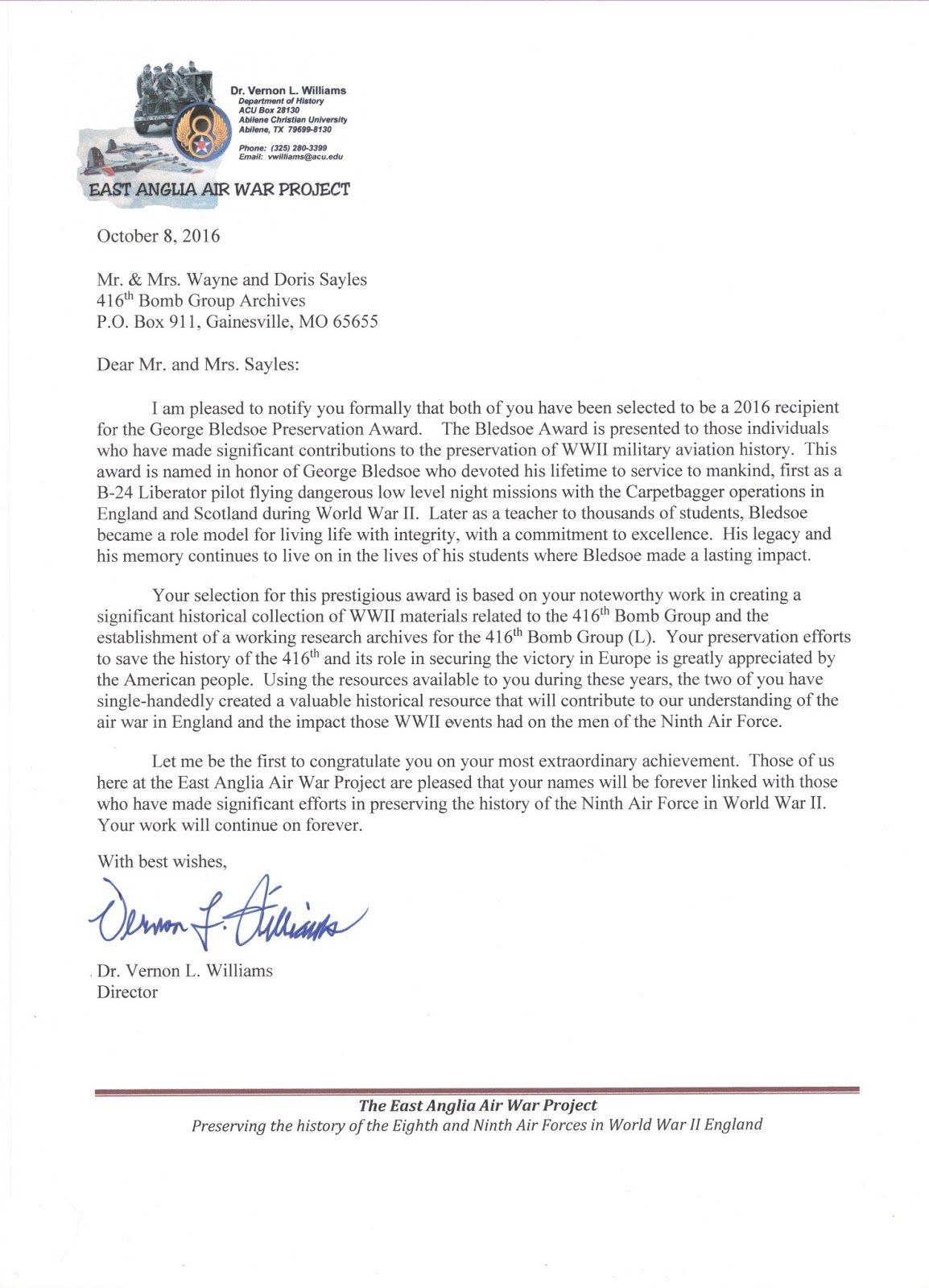
A large part of the success enjoyed by this Archive, still in its infancy, is due to the sense of ownership that surviving veterans and the families of deceased veterans have in this not-for-profit facility.  Donations of original WWII records, photographs, letters, diaries and memorabilia of all sorts are literally pouring into the research center, as are offers of help from volunteers with exceptional backgrounds and dedication.  All of this activity has not gone unnoticed or unheralded.  At the 2016 reunion of 416th veterans, hosted by the Archive in Gainesville, Dr. Vernon L. Williams recognized the Archive and its founders with the East Anglia Air War Project's  George Bledsoe Preservation Award.  Dr. Williams is the Air War Project's Director and Professor of History at Abilene Christian University in Abilene, Texas.

 Dr. Vernon Williams reads the designation of 
George Bledsoe Preservation Award for 2016 to 
Doris and Wayne Sayles, founders of the 416th Bomb Group Archive 


The Archive plays an ever-increasing role in reconsructing the life and times of those who played such a crucial role in the tactical air war over Europe in 1944 and 1945


Tuesday, August 2, 2016

Old Fart Pride

Author Anonymous — but everyone in the 416th Bomb Group family knows, or knew, at least one "Old Fart".

It's not a bad thing to be called an Old Fart.
Old Farts are easy to spot at sporting events; during the National Anthem, Old Farts remove their hats and stand at attention and sing without embarrassment. They know the words and believe in them.

Old Farts remember World War II, Normandy , Spitfires and Hitler. They remember the Atomic Bomb, Vietnam , the Korean War, the Cold War, the Moon Landing and all the Peacekeeping Missions along the way.

If you bump into an Old Fart on the pavement, he will apologize. If you pass an Old Fart on the street, he will nod or tip his cap to a lady. Old Farts trust strangers and are polite, particularly to women.

Old Farts hold the door for the next person and always, when walking, make certain the lady is on the inside for protection.  Old Farts get embarrassed if someone swears in front of women and children and they don't like any filthy language on TV.  Old Farts have moral courage and personal integrity. They seldom brag except about their children and grandchildren.

It's the Old Farts who know our great country is protected, not by politicians, but by the young men and women in the Air Force, Army, and Navy.

This country needs Old Farts with their work ethic, sense of responsibility, pride in their country and decent values.

We need them now more than ever.

Thank Goodness for Old Farts!  I was taught to respect my elders. It's just getting harder to find them.

Sunday, May 29, 2016

Open Letter to Bill Cramsie


Dear Bill;

I remember the moment we first met like it was yesterday.  Actually, eleven years ago now—but I suppose time has little meaning for you these days.  You reached out and touched my shoulder as I held your West Point ring in my hand that day.  It was a mysterious and magical moment.  I've told others about the feeling, but how could anyone ever really comprehend?  The journey you set in motion that day, for an amazing number of people, has no parallel in the world that I know.  Through meeting your relatives, friends and others like us that you've inspired, my wife Doris and I found a warm and caring 416th family that immediately took us under wing.  The search to know more about you became an adventure and a common desire to honor not only your memory and sacrifice, but that of your comrades as well.

When I first saw your picture in the June-1943 West Point yearbook it was heartbreaking.  What must your mom and Marnelle have felt back in Auburn when they received that dreaded telegram?  Your young Godchild, Judy, was there as well—out of school for Easter vacation—and recounted the painful story for me from a child's perspective.  The children of your brother Bob and sister Ruth have spoken to me often about the years of silence afterward.  None could bear to talk about you without breaking down in tears.

The comments beneath your yearbook photo talked about your exceptional ability to "drag pro".  I had no idea  what that meant until I met your USMAY classmate and 671st squadron pal Dick Wheeler.  When Dick explained that it meant to date the loveliest of the young ladies that attended Academy social events, I was not surprised.  Nor was I surprised when Bob Basnett told me all about the double-dates that you and he had with Dee Rogers and Clemie Smith in New York.  The wheels were turning faster than I could ever have imagined and I have little doubt that I was being spoon fed from a spiritual source.  You led me to Dee shortly before she passed away and through her I learned about the love between you that had blossomed at the Academy while you were there.  What a trail of broken hearts the price of freedom leaves.

In the aftermath of your tragedy, you may have wondered how so many things could have gone wrong on that fateful day.  With your guiding hand, answers are now starting to surface.  The 416th Bomb Group family is growing today in size and in unity while many other WWII veteran groups are disbanding.  416th veterans, living and departed, are being recognized worldwide for their wartime accomplishments.  The search for 9699 is still very much alive and one day we expect to pay our respects at that war grave.

On this Memorial Day, 2016, I salute your sense of Duty, Honor and Country.


Sunday, April 10, 2016

Bill Cramsie Day

On this day in 1944, Bill Cramsie climbed into the cockpit of an A-20G attack bomber (43-9699) and methodically went through the warm-up checklist.  It was the 4th combat mission for this West Point graduate and already he was flying in the #3 slot of the lead box of 18 planes -- on the left wing of Major Willets, the 671st Squadron Commander.  Those who knew him and survived are in agreement that he was an outstanding pilot with a promising future.  They were airborne by 8:44 AM and at the scheduled target in France an hour later.  Unfortunately, the cloud cover at that point was 10/10 or total.  The V-1 Buzz Bomb launch site they were hopeful of destroying could not be seen.

The German antiaircraft batteries on the ground had no such disadvantage.  Their radar controls told gunners exactly where the 416th planes were and the barrages they sent aloft were deadly.  As the bombers made another pass over the target the flak became very intense and every plane in the 36-ship-formation suffered from flak damage.  Bill Cramsie lost an engine on the first pass and stayed with the group for the second pass where he reportedly was hit again.  As the lead navigator sought a suitable alternate target, the flight passed into a cloudless area to the north that happened to be above another Buzz Bomb site.  The group dropped their bombs on this target of opportunity and headed home.  Bill, unable to stay with the formation as his remaining engine weakened, fell out of formation.  As they headed back across the English Channel, his academy classmate and friend Scotty Street also lost an engine and fell behind along with Bill who was then in sight below him.  As they crossed Bradwell Bay, losing altitude, both Bill and Scotty were seeking an emergency landing strip.  Both called for bearings to the RAF field nearby and received them from Air Search and Rescue.  At that point, Bill dropped below the clouds at about 400 feet altitude and Scotty made a turn to the West to line up with the Bradwell Bay landing strip.

Scotty's crew bailed out over land and he crash-landed without injury, though the plane was beyond repair.  Bill and his crew disappeared.  A Rescue team was never dispatched.  Seventy years later, Chief Inspector Ross Stewart of the British Minstry of Defense Police discovered why.  The coordinates captured from radio direction finding equipment during Bill's call for help were transposed.  Instead of placing his aircraft just offshore near the RAF airbase, they indicated he was some 40 miles east of there over the North Sea.  Of course there was no way for boats to reach that spot in time to do any good and it seems therefore that no effort was made.  Based on eye-witness reports, it is virtually certain that Bill Cramsie, his plane and his crew lie unrecovered in Bradwell Bay -- probably in very shallow water not far off shore.  That realization has spurred considerable interest in generating a serious search for the A-20 and its crew.   Hopefully on Bill Cramsie Day a year from now we will be able to share some more encouraging news about that search for "9699".

Saturday, May 23, 2015

Memorial Day 2015

416th Men Still Missing in Action (ABMC Wall of the Missing) 

 Memorial Day is a time to remember those who gave their lives to preserve all the things that we hold dear about life in America.  There are far too many of them to even attempt to know or name them all, but we will concentrate here today on ten young men.  They are the 416th Bomb Group crew members who are lost in time.  Ten of the members of this Group who died in combat still do not yet have a final resting place.  Six of them were lost on one tragic mission.  That might seem like a small number when one contemplates the enormity of World War II, but to each of those ten families it was and remains a cross to bear.  Technically, the search for these men is ongoing, but as a practical matter all have since been declared "non-recoverable" by the U.S. Government.  Fortunately, there are many here and abroad who choose not to accept that finality and the search for them goes on. 

Raines, Arthur A. Jr.     2Lt    669    10Apr44    ABMC Cambridge Wall
Bender, Glenn J.           SSgt   669    10Apr44   ABMC Cambridge Wall
Nielsen, Jack O.           SSgt   669    10Apr44   ABMC Cambridge Wall
Cramsie, William E.     1Lt     671    10Apr44   ABMC Cambridge Wall
Henshaw, Charles R.    SSgt   671    10Apr44   ABMC Cambridge Wall
Steward, Jack               SSgt   671    10Apr44   ABMC Cambridge Wall
Cruze, Raymond K.     1Lt     668    18Jul44     ABMC Cambridge Wall
Murphy, Thomas A.     1Lt     670    1 Jan 45    ABMC Ardennes Wall
Kiker, Charles M.         Sgt     669    14Jan45    ABMC Lorraine Wall
Griffith, John J. Jr.        Sgt     668    18Mar45   ABMC Lorraine Wall

Friday, April 10, 2015

Remembering William Edward Cramsie


There are a number of days on the calendar that have special meaning to each of us.  Some have special meaning to most of us.  One of those days with special meaning to me personally is April 10th.  It was on this day in 1944 that William Edward Cramsie died in a valliant fight to defend freedom.  I didn't even know his name until 2005 when by chance I became the steward of Bill Cramsie's West Point class ring.  That is an interesting story in itself, but not for this post.  What is important on this day is that we remember those brilliant young men who had their whole lives before them and willingly gave them up in defense of Freedom.  There is no way to place a value on that.  Since 2005, I have come to love Bill Cramsie for what he stood for.   It is a great honor for me to mention his name and to talk with those who knew him personally.  Humanity is challenged almost daily, and maybe even moreso now than then, by one scourge or another.  in the face of that, we need to be true to our principles like Bill was.  It isn't always easy but it is necessary.

Bill Cramsie grew up in the foothills of the mountains dividing California from Nevada.  he was a leader from day one.  His dream was to become an aviator and to attend West Point.  He did that.  Everyone that I have met who knew Bill Cramsie, and there have been more than a few, had the same opinion of him.  Bill was a friendly, easy going and conscientious young man.  He made friends without even trying.  He graduated from West Point in the top 10% of his class, but never was pretentious or ostentatious to those he served with, especially not to the enlisted personnel who worked with him.

We might all model our lives after that of Bill Cramsie and think about the effect that we have on the world around us.  If we do nothing but satisfy our own needs, we are the enemy of civilization.  We cannot all be heroes, like Bill, but we can all do our best to make the world a better place to live.

Wall of the Missing at Cambridge American Cemetery in England

Sunday, May 25, 2014

On Memorial Day we honor
those who died in service
to our country.

Memorial Day 2014

Let us pause for a moment to consider the significance of this day — set aside to honor those who have fallen in combat to preserve the freedoms that we still enjoy.  Nearly 100 members of the 416th Bomb Group lost their lives in combat.  Some were repatriated to the United States for burial, others were interred in American Battlefield Monument Cemeteries throughout Europe and Great Britain.  We could never do justice to all of them in a short message like this, but we will at least pay humble tribute to one, in memory of all.


Francis W. DeMand grew up in Wichita, Kansas, the son of a country doctor who died of pneumonia in 1926 while Francis was just a young boy.  He and his two sisters were raised by their mother, Martha, who ran a rooming house during the depression years.   Francis graduated from high school with war on the horizon and joined the Army with four of his high school buddies.  They all were enlisted at the same time, took flight training together and earned commissions as pilots in the Army Air Corps.  Lieutenants DeMand, Merchant, Morton, McDonald and Ritter all became A-20 Havoc pilots and were part of the initial cadre that joined the 416th Bomb Group at Oklahoma City. 


Lt. Robert Morton died in an aircraft training accident at Vinton, LA in 1943 and Lt. Arthur McDonald was killed when his plane crashed near London, England in April of 1944.  Lt. Ritter was transferred to the South Pacific, but survived the war and returned to Wichita, as did Lt. William Merchant, DeMand's closest friend and fellow pilot in the 671st.  In the photo below, Francis and Lt. Merchant stand before the A-20 "Uncle Bob" flown by DeMand.


Lt. DeMand was leading Box II, Flight 3 on September 29, 1944 in an attack on the railroad marshalling yards at Julich, Germany.  Lt. Dave Andrews was flying on DeMand's left wing, only a few yards away.  Dave recalls the event with absolute clarity in a "Witness to War" video seventy years after the fact.  An artillery barrage destroyed DeMand's plane in a direct hit, killing all but Ssgt Middleton, one of the gunners, who was blown clear of the plane by the explosion.  Originally buried in Germany, the remains of Lt. DeMand and of his Bombardier/Navigator Alwin Burns, were transferred after the war to the ABMC cemetery at Margraten, Netherlands.  The family of nearby resident Ron Wintjens has adopted the Grave of Francis and honors his memory on special occasions like this.  DeMand's gunner, Ssgt Reuben Troyer is buried at the ABMC cemetery in Ardennes. 


Ron Wintjens family (above) pays respects to Francis DeMand Grave at Margraten ABMC Cemetery.  Thanks to the generosity of Rick Greer, a nephew of this hero, the 416th Archive now has a rich collection of photos and documents about his life and service.  We are proud to honor Francis DeMand  this Memorial Day as we remember all those who died in service to their country.


Thursday, April 10, 2014

Seventy Years Later - Still Missing


On April 10, 1944—the day after Easter—1Lt William Edward Cramsie awoke before dawn and dressed in his flight suit for what were still very cold conditions at 12,000 feet with no cabin heater.  Following a quick breakfast and a mission briefing at the 416th Bomb Group operations center, a pre-fab Nissen Hut near the Wethersfield flight line, Bill caught a ride out to the hardstand in the back of a canvas covered weapons carrier.  The mood was light as this would be the first combat mission flown by the group since March 26th.  The A-20 Havoc crews were anxious to get back into the air.  They had been socked-in by miserable weather in England for two weeks and wanted to get back to business.  As the "taxi" dropped Bill off at an awesome new "G" model, he noted the tail number 39699 and wondered why they left off the 4?  Not that it really mattered.  The fuselage code "5C" for 671st Bomb Squadron and individual identifier "I" were more important.  Pilots and crews of the planes normally referred to their aircraft only by the last three digits anyway.  At "699", Bill met Staff Sergeants Charles Henshaw and Jack Steward.  They would be the turret and tunnel gunners flying with him on this mission—his fourth combat sortie.

The early enthusiasm was short lived.  As the flights approached France, bound for the V-1 launch site at Bois des Huit Rues, they were met with 10/10 cloud cover—solid overcast.  While Peter Royalty, the lead bombardier/navigator, searched fruitlessly for their assigned target the German anti-aircraft batteries with their radar controlled firing centers had no visual impediment.  Flak was intense as multiple passes over the target area gave the enemy ample opportunity to zero in on them.  The result was devastating.  Every ship in the formation sustained battle damage, three were lost.  Arthur Raines was the first to go down somewhere near Hazebrouck.  Bill's plane was hit on the first pass and lost an engine, but stayed with the formation for a second pass.  This required that the remaining engine be pushed to its limits in order to keep in position.  He was hit again on the second pass.  With the cloud cover abating somewhat to the north, the formation eventually bombed a target of opportunity about 18 miles northwest of its primary target.  As they headed back to England, Bill's West Point classmate and friend Scotty Street was also hit and lost an engine.  Both of them fell out of the formation and started losing altitude.  Lt. Street was able to make an emergency crash landing at RAF Bradwell Bay after his gunners bailed out.  Bill Cramsie was heard contacting the same field and receiving a bearing to base.  He never made it. 

And so began the first day of a seventy-year-long Homeric tale that has yet to see its final chapter.  Like Protesilaus, the first Greek killed in the Trojan War, Bill Cramsie was the first member of his West Point graduating class (June, 1943) to die in combat—the First to Fall.  The similarities are not merely poetic.  Protesilaus was a suitor of Helen, considered in Greek myth to be the most beautiful woman in the world.  At the academy, Bill met and fell in love with Dee Rogers.  The Irish reincarnation, without a doubt, of Helen. 
Protesilaus was from coastal Antron, a land described by Homer as "deep in grass".  Bill's grandfather came to America from county Antrim in Ireland, a land famous for its green Glens.  History did little to preserve the memory of Protesilaus or of Bill Cramsie, they both are remembered because of the irony and tragedy of their death and the remarkable endurance of their spirit.  At the British Museum in London is one of the few surviving representations of Protesilaus, a Roman stone torso.  Also in Britain, on the Wall of the Missing at Cambridge American Cemetery (Madingley), is engraved in stone one of the few public memorials to Bill Cramsie.

The search for Bill and his crew did not really begin until about three years ago when Ross Stewart,
at the time a Ministry of Defence Police inspector at Wethersfield, accepted the challenge of finding "699".  In studying the Missing Air Crew Report,  Individual Deceased Personnel Files, and other documents, the law enforcement training of Ross became an important asset.  He identified a transposition of numbers in the original reported position of Bill and crew.  What could only have been a last known position of one degree, 05 minutes longitude was formally recorded as one degree, 50 minutes.  The difference amounts to about 40 miles and placed "699" well into the North Sea instead of very close to land in Bradwell Bay.  Consequently, no search was initiated at the time.  This and other corroborating evidence would place the last known position of "699" on or near Buxey Sand, merely a few miles from the point on which the RAF base was located.  Two visits by Ross and local volunteers to this shallow sand bank have identified WWII aircraft wreckage, but have not been able to confirm any of it yet as that of an A-20 Havoc.

As we mark this 70th year since the loss of Bill and crew, we remain hopeful that new technologies and continued research will one day lead us to whatever remains of this heroic but virtually unheralded crew and will provide the long awaited and much deserved closure for all those who care.

Friday, March 21, 2014

Irish to the end

When Bill Cramsie arrived at West Point in the summer of 1940 he was assigned to "Easy Company". Before long, a restructuring of the Corps of Cadets transferred Bill to Company G-1 the "G-Nomies" as they were referred to affectionately by their fellow cadets.  Sharing a room with cadet Cramsie was a stocky and ebullient New Orleans native Bob Rooney.  Both Cramsie and Rooney chose the Army Air Corps as their future and became pilots together as well as close friends.  Following graduation and advanced pilot training, they both were assigned to the 416th Bomb Group at Lake Charles, Louisiana.  Bill was assigned to the 671st Bomb Squadron, Bob was assigned to the 670th Bomb Squadron.   They became and remained close friends.


William Edward Cramsie
Robert John Rooney
 
As fate would have it, both were lost in combat during WWII.  Bill went down in Bradwell Bay on April 10th, 1944 (416th Mission #10).  Bob tragically died on his 65th and last required mission March 21st, 1945 (416th Mission #246).  The mission to Vreden, Germany on this day 69 years ago was successful and the aircraft were returning to base.  Bob Rooney was leading one element of A-26 Invaders.  Another element of 416th aircraft trying to join a formation ahead of Rooney was on a collision course with Rooney's flight as they flew west into the Sun low in the sky before them.  The leader of that flight, apparently blinded by the Sun, overran Rooney's plane and both ships went down with all lost except Rooney's bombardier/navigator Robert Kirk.

It was a tragedy in every sense of the word.  Rooney's friends awaited his return to celebrate his impending transfer back to the U.S.  There would be no celebration this day.  Earlier this week, my wife Doris and I visited the grave of Bob Rooney at Greenwood Cemetery in New Orleans.  It was a very poignant moment and we felt humbled to be in the presence of Rooney's spirit as representatives of those veterans still with us and the 416th extended family.  His memory and that of his dear friend Bill Cramsie shall not fade as long as there is breath among those who know of their deeds and dedication.  We are saddened but honored to remember both of these heroes today.


Saturday, March 1, 2014

A few names that the older generation might recognize

From an anonymous email, proof that there once was a day when Hollywood did more than protest:

*       Stewart Hayden, US Marines and OSS. Smuggled guns into Yugoslavia and parachuted into Croatia.

*       James Stewart, US Army Air Corps. Bomber pilot who rose to the rank of General.

*       Ernest Borgnine, US Navy. Gunners Mate 1c, destroyer USS Lamberton.

*       Ed McMahon, US Marines. Fighter Pilot. (Flew OE-1 Bird Dogs over Korea as well.)

*       Telly Savalas, US Army.

*       Walter Matthau, US Army Air Corps., B-24 Radioman/Gunner and cryptographer.

*       Steve Forrest, US Army. Wounded, Battle of the Bulge.

*       Jonathan Winters, USMC. Battleship USS Wisconsin and Carrier USS Bon Homme Richard. Anti-aircraft gunner, Battle of Okinawa.

*       Paul Newman, US Navy Rear seat gunner/radioman, torpedo bombers ofUSS Bunker Hill

*       Kirk Douglas, US Navy. Sub-chaser in the Pacific. Wounded in action and medically discharged.

*       Robert Mitchum, US Army.

*       Dale Robertson, US Army. Tank Commander in North Africa under Patton. Wounded twice. Battlefield Commission.

*       Henry Fonda, US Navy. Destroyer USS Satterlee.

*       John Carroll, US Army Air Corps. Pilot in North Africa. Broke his back in a crash.

*       Lee Marvin US Marines. Sniper. Wounded in action on Saipan. Buried in Arlington National Cemetery, Sec. 7A next to Greg Boyington and Joe Louis.

*       Art Carney, US Army. Wounded on Normandy beach, D-Day. Limped for the rest of his life.

*       Wayne Morris, US Navy fighter pilot, USS Essex. Downed seven Japanese fighters.

*       Rod Steiger, US Navy. Was aboard one of the ships that launched the Doolittle Raid.

*       Tony Curtis, US Navy. Sub tender USS Proteus. In Tokyo Bay for the surrender of Japan.

*       Larry Storch. US Navy. Sub tender USS Proteus with Tony Curtis.

*       Forrest Tucker, US Army. Enlisted as a private, rose to Lieutenant.

*       Robert Montgomery, US Navy.

*       George Kennedy, US Army. Enlisted after Pearl Harbor, stayed in sixteen years.

*       Mickey Rooney, US Army under Patton. Bronze Star.

*       Denver Pyle, US Navy. Wounded in the Battle of Guadalcanal. Medically discharged.

*       Burgess Meredith, US Army Air Corps.

*       DeForest Kelley, US Army Air Corps.

*       Robert Stack, US Navy. Gunnery Officer.

*       Neville Brand, US Army, Europe. Was awarded the Silver Star and Purple Heart.

*       Tyrone Power, US Marines. Transport pilot in the Pacific Theater.

*       Charlton Heston, US Army Air Corps. Radio operator and aerial gunner on a B-25, Aleutians.

*       Danny Aiello, US Army. Lied about his age to enlist at 16. Served three years.

*       James Arness, US Army. As an infantryman, he was severely wounded at Anzio, Italy.

*       Efram Zimbalist, Jr., US Army. Purple Heart for a severe wound received at Huertgen Forest.

*       Mickey Spillane, US Army Air Corps, Fighter Pilot and later Instructor Pilot.

*       Rod Serling. US Army. 11th Airborne Division in the Pacific. He jumped at Tagaytay in the Philippines and was later wounded in Manila.

*       Gene Autry, US Army Air Corps. Crewman on transports that ferried supplies over "The Hump" in the China-Burma-India Theater.

*       Wiliam Holden, US Army Air Corps.

*       Alan Hale Jr, US Coast Guard.

*       Harry Dean Stanton, US Navy. Battle of Okinawa.

*       Russell Johnson, US Army Air Corps. B-24 crewman who was awarded Purple Heart when his aircraft was shot down by the Japanese in the Philippines.

*       William Conrad, US Army Air Corps. Fighter Pilot.

*       Jack Klugman, US Army.

*       Frank Sutton, US Army. Took part in 14 assault landings, including Leyte, Luzon, Bataan and Corregidor.

*       Jackie Coogan, US Army Air Corps. Volunteered for gliders and flew troops and materials into Burma behind enemy lines.

*       Tom Bosley, US Navy.

*       Claude Akins, US Army. Signal Corps., Burma and the Philippines.

*       Chuck Connors, US Army. Tank-warfare instructor.

*       Harry Carey Jr., US Navy.

*       Mel Brooks, US Army. Combat Engineer. Saw action in the Battle of the Bulge.

*       Robert Altman, US Army Air Corps. B-24 Co-Pilot.

*       Pat Hingle, US Navy. Destroyer USS Marshall

*       Fred Gwynne, US Navy. Radioman.

*       Karl Malden, US Army Air Corps. 8th Air Force, NCO.

*       Earl Holliman. US Navy. Lied about his age to enlist. Discharged after a year when they Navy found out.

*       Rock Hudson, US Navy. Aircraft mechanic, the Philippines.

*       Harvey Korman, US Navy.

*       Aldo Ray. US Navy. UDT frogman, Okinawa.

*       Don Knotts, US Army, Pacific Theater.

*       Don Rickles, US Navy aboard USS Cyrene.

*       Harry Dean Stanton, US Navy. Served aboard an LST in the Battle of Okinawa.

*       Robert Stack, US Navy. Gunnery Instructor.

*       Soupy Sales, US Navy. Served on USS Randall in the South Pacific.

*       Lee Van Cleef, US Navy. Served aboard a sub chaser then a mine sweeper.

*       Clifton James, US Army, South Pacific. Was awarded the Silver Star, Bronze Star, and Purple Heart.

*       Ted Knight, US Army, Combat Engineers.

*       Jack Warden, US Navy, 1938-1942, then US Army, 1942-1945. 101st Airborne Division.

*       Don Adams. US Marines. Wounded on Guadalcanal, then served as a Drill Instructor.

*       James Gregory, US Navy and US Marines.

*       Brian Keith, US Marines. Radioman/Gunner in Dauntless dive-bombers.

*       Fess Parker, US Navy and US Marines. Booted from pilot training for being too tall, joined Marines as a radio operator.

*       Charles Durning. US Army. Landed at Normandy on D-Day. Shot multiple times. Awarded the Silver Star and Bronze Star and three Purple Hearts. Survived Malmedy Massacre.

*       Raymond Burr, US Navy. Shot in the stomach on Okinawa and medically discharged.

*       Hugh O'Brian, US Marines.

*       Robert Ryan, US Marines.

*       Eddie Albert, US Coast Guard. Bronze Star with Combat V for saving several Marines under heavy fire as pilot of a landing craft during the invasion of Tarawa.

*       Clark Gable, US Army Air Corps. B-17 gunner over Europe.

*       Charles Bronson, US Army Air Corps. B-29 gunner, wounded in action.

*       Peter Graves, US Army Air Corps.

*       Buddy Hackett, US Army anti-aircraft gunner.

*       Victor Mature, US Coast Guard.

*       Jack Palance, US Army Air Corps. Severely injured bailing out of a burning B-24 bomber.

*       Robert Preston, US Army Air Corps. Intelligence Officer

*       Cesar Romero, US Coast Guard. Coast Guard. Participated in the invasions of Tinian and Saipan on the assault transport USS Cavalier.

*       Norman Fell, US Army Air Corps., Tail Gunner, Pacific Theater.

*       Jason Robards, US Navy. was aboard heavy cruiser USS Northampton when it was sunk off Guadalcanal. Also served on the USS Nashville during the invasion of the Philippines, surviving a kamikaze hit that caused 223 casualties.

*       Steve Reeves, US Army, Philippines.

*       Dennis Weaver, US Navy. Pilot.

*       Robert Taylor, US Navy. Instructor Pilot.

*       Randolph Scott. Tried to enlist in the Marines but was rejected due to injuries sustained in US Army, World War One.

*       Ronald Reagan. US Army. Was a 2nd Lt. in the Cavalry Reserves before the war. His poor eyesight kept him from being sent overseas with his unit when war came so he transferred to the Army Air Corps Public Relations Unit where he served for the duration.

*       John Wayne. Declared "4F medically unfit" due to pre-existing injuries, he nonetheless attempted to volunteer three times (Army, Navy and Film Corps.) so he gets honorable mention.

*       And of course we have Audie Murphy, America's most-decorated soldier, who became a Hollywood star as a result of his US Army service that included his being awarded the Medal of Honor.




Sunday, July 21, 2013

Lessons of life


Over the past decade, I have not only become a "Senior Citizen" and a septuagenarian but intuitively I sense that I may be a more sensitive person than I was in years past.  The very fact that I put that observation on the public table here is probably evidence in itself.  I'm not sure whether it's a good thing or just an inevitable reaction to aging, but it clearly is an observation that those close to me might have seen even before I did — at least one would hope so.  That sensitivity was brought home in a poignant way this weekend as we lost a very close and dear companion.

On Easter weekend of 1998, an emaciated and tick-ridden puppy wandered into our lives.  Only a few months old, she staggered into our carport and decided that was the place she would die.  Doris and I were not ready to introduce a dog into our world, but neither were we willing to ignore the needs of an animal in distress.  To make a long story short, we nursed her, nurtured her and ultimately fell in love with her.   Little did we anticipate that her choice would become reality or the pain that her departure would leave in our hearts.

She was a pure-bred Portuguese Water Dog, a rare breed in the U.S. and not the sort of dog that people generally abandon on a lonely country road.  We named her Pasha, after the high born Turkish rulers of the Ottoman era.  It is impossible to describe the disposition of this remarkable creature.  She embodied all of the positive and lovable traits that one might put on a wish list.  It is claimed that dogs do not "love",  but this one most certainly did and it was contagious.  We were a family that traveled often in those early years and Pasha went everywhere with us.  A more congenial and obedient dog has never been born.  To avoid submitting her to the unpleasantness of a dog kennel, we purchased a motorhome and it became our mobile kennel on many trips across the country—including five 416th Bomb Group reunions.  About five years ago, Pasha became the big sister to a bundle of dynamite that we named Ghazi.  She handled the task well.  When Doris and I went to Ireland a few years ago, our dear friend Norrie Rawdon came all the way from Texas to sit with Pasha and Ghazi at our home in Missouri.  Few dogs have had life better, but even fewer dogs have given so much in return.

Pasha was nearly 16 years old when she passed away quietly at home in the arms of those she loved and who loved her beyond measure in return.  She is interred near the base of a vibrant pear tree here at the place she chose to die.  We are ever so grateful she made that choice and for the many years that we had with her between then and now.  Her life was more than an appendage to our own, it was a lesson that we needed to absorb in our own lives.  I believe that has been the case and we will remember her always with gratitude for it.

Sunday, May 26, 2013

"This land was your land, this land was my land…"

Wall of the Missing - ABMC Cemetery, Cambridge, England
Woody Guthrie would roll over in his grave if he could see his endless skyway and golden valley today.  Guthrie was an idealist who influenced a pivotal generation in America.  He died in 1967, at what some might consider the beginning of the New Depression.  Raised during the Great Depression of the Thirties, Guthrie reacted to economic and political crises in his popular Folk Music.   By contrast, the Depression that has overwhelmed America since then is one of spirit.  With few exceptions, the trauma of the 1960s has divided and scarred American society in ways too momentous to recount.  The roller coaster of economic prosperity these past 50 years is easily tracked on charts and graphs, but less measurable and certainly more insidious is the steady degradation of the ideals that Americans shared during World War II— ideals and initiatives that led to America becoming the pre-eminent world power that we precariously enjoy to this day.

The pace of life in the 21st century is governed by the technology explosion, but society is not as readily adaptable to change as technology is.  The way people lived and coped with life 50 years ago was far different than it is today.  That's not because the problems faced then were any more, nor less, pressing.  It seems that the prevailing attitudes, about many things, were different and that there was indeed a prevailing attitude.   Not least of the many changes has been our national unity of belief.  During WWII, Americans shared a common purpose and resolve. Today, the country is split almost equally between two diametrically opposed views.  The old jokes about gridlock in Washington are no longer funny.  Gridlock has become a way of life and more people than ever in America lack faith in almost every facet of their existence.  For most, it is enough to simply make it through the day.  One of the real tragedies of this New Depression is that we have abandoned the traditions and social institutions that made America great.   Government is rarely viewed these days as a friend, much less a protector.   Industry and labor are seldom rewarded and entitlement has replaced ambition.

In our post "sixties" zeal for political correctness, we have gradually whittled away the foundations upon which this nation was built.  One of the many examples lies before us today.  As we prepare to celebrate "Memorial Day" it would be hard to find any unity of view on what the day even represents.  The U.S. Department of Veterans Affairs well knows that "Memorial Day is a day of remembering the men and women who died while serving in the United States Armed Forces."  Not veterans who served in war, or peace, but those who "died" serving.   This day of remembrance originated after the Civil War, when 600,000 died, and was called "Decoration Day" until 1882.  For more than a century, Americans made visits on this day to decorate the graves of those fallen warriors, with flags and flowers, to single them out for their gallantry and devotion.  All other veterans are honored on "Veterans Day" in November. 

This day of remembrance was initially established as May 30th, but Congress changed the date in 1971 to the last Monday in May in order to create an annual three-day weekend.  The Veterans of Foreign Wars still oppose this change, arguing that it undermines the very meaning of the day and pointing to the consequent nonchalance of the public about observing traditional ceremonies.  It would be hard to argue that Memorial Day means the same thing to Americans today as it did in 1945.  The three-day weekend is now the most anticipated aspect and is punctuated by auto racing and golf events in addition to a plethora of holiday shopper sales—more like May Day.   The visitation of graves and placing of flowers is still fairly common, but even that has become a generic family activity for many—associated with remembrance of all who have died, not just those who died in service to their country.   While the remembrance of ancestors is an important family activity, the fact that it merges so indiscriminately with Memorial Day is another reason for the vanishing significance of this particular day.

On this Memorial Day, I personally will be honored to pay my respects to those fallen members of the 416th Bomb Group who, like Bill Cramsie, died between 1943 and 1945 in service to our country.  They were among the best of America's youth and they left us a tremendous gift.  We should take this occasion to rededicate ourselves to making a difference in the future of this country so that it will continue to be "my land and your land" and will lead the free world by example as those before us so admirably did.  It is our duty and our privilege to preserve, protect and nurture their legacy.

Thursday, May 23, 2013

And the wheel goes round and round

I woke up this morning at 9:00 AM when the cell phone rang six inches from my ear and Ghazi jumped over top of me landing on the floor with a thud.  It's not that I'm an especially late sleeper, but somehow the curtain of bliss had blessed me with an extra couple hours.  Ghazi, a young and aptly named Black Lab / Border Collie mix, wasted no time heading for the front door as dogs are prone to do.  That caught the eye of Pasha, our 16-year-old Portuguese Water Dog who is hard of hearing, sees poorly and barks loudly when reminded that the world is still turning.   I expected the call to be from my wife Doris, who is on her way back home from a family emergency in Arkansas.  Instead, it was someone else near and dear to my heart—the IRS.  The potential for bliss to turn on a dime into chaos was definitely there.  Maybe it was just the startled awakening, but I thought I heard a deep soothing voice saying "It is not your time". The call was from my IRS advocate.  Yes, I am awake now and yes I do have an advocate at the IRS.  Never heard of such a thing?  Neither had I until I was assigned one.  Ironically, the U.S. Government employs a corps of agents to advocate for citizens who have found the IRS to be overly complex or unresponsive.  I don't know how many of these advocates are on the payroll, but I do know that they are well schooled in the nuances of bureaucracy—and dealing with the public. 

Seven years ago,  Doris and I were introduced to (and embraced by) the remarkable extended family of the 416th Bomb Group.  The veterans of this WWII combat unit have held annual reunions in one form or another virtually since the war ended.  We hosted a couple of these reunions at Branson, Missouri and will host the 2013 reunion in Gainesville, Missouri this coming October.  At one of the Branson reunions the topic of historical preservation came up.  There really was not any active repository for the treasured memories and memorabilia of these veterans.  The issue had become pressing due to the fact that many of those veterans had passed on and their spouses sometimes were faced with difficult choices about disposing of photos, documents, letters, diaries, etc.  As an interim measure, we agreed to store any of these objects that families were not prepared to retain themselves.  

Not too long after that, the local "City Hall" in Gainesville was listed for sale when the city government moved into larger quarters.  The old facility was built from hand-cut limestone in 1935 in the style of many WPA buildings of that era.  Doris and I purchased the building and began an extensive remodel and restoration.  Although privately owned, this building soon became the home of the 416th Bomb Group Archive.  The Archive has been registered with the State of Missouri as a non-profit corporation with a Board of Directors and survivorship provisions.  In October of 2012, the Archive filed an application form (and $400 fee) for 501c3 tax exempt status with the Internal Revenue Service.  The form instructions optimistically tell the filer to call the IRS if a response is not received within 30 days.  The time passed and the call was made.  The IRS agent contacted was polite but seemingly unconcerned.  He stated that the application was being held up because more information was needed.  When asked what information was required, he could not provide that information.  When asked who could provide that information, he stated that the application had been assigned to "someone" who would contact us in this matter.  The winter came and went and the IRS remained silent. 

After several months had passed, we appealed to Senator Blunt's office for assistance in resolving the issue with IRS.  It was because of this appeal to the Senator that the IRS assigned an Advocate to us.  Since this application is really a formality, and there is no significant monetary impact on the U.S. revenue system, one would think that it would be less expensive to find the paperwork and approve it than to hire an advocate and perpetuate the paper trail with added human resources and further delays.   Instead, the advocate asked that we provide essentially the same justification that we did in the initial application as well as income/expense statements and impact statements—which we did.  The purpose of the call from our advocate this morning was to advise that our information had been received and would be forwarded to the IRS department responsible, but that "Expedited" action by the IRS was not likely.  Say What?  The U.S. government has been sitting on this application for seven months and it would take "Expedited" action to approve it?  My blood pressure was beginning to rise, but the disarming nature of the Advocate diffused what could easily have become a melt-down (not that a melt-down would have done any good).

The whole point of requesting 501c3 status is to facilitate federal tax deductions for donations made to the Archive.  Since the Archive pays no rent, has no paid employees, no compensation for directors and no expense accounts for managers, there can be little confusion about where the income from donations goes.  It is used entirely for operational support.  The Archive website at http://416th.com is one of the most comprehensive resources and valuable online research tools of any WWII combat unit.  The Archive Facebook page has drawn together 416th family and friends from across the country and even from England and Europe.  The Archive video taping program has preserved more than 50 hours of interviews with 416th veterans.  The black granite Wall of Honor at the Archive has some sixty names of veterans already engraved and more to come.  The Archive digital and original copy files already include tens of thousands of pages of directly related historical documents and new accessions are constantly adding to that resource.

When will the IRS see fit to approve the 416th Bomb Group Application?  That's a question for the ages.  Rest assured it will not be this week as everyone is on holiday celebrating the contributions of these same veterans.   It reminds me of the old folk song about the "Man who never returned".  Meanwhile, the uncertainty does little to encourage growth and the window for capturing memories of these WWII veterans is rapidly closing.  Fortunately, we have an advocate on our side.  What might the situation be without this government generosity?

Have to run now, the dogs are at the door barking to get back in.


Saturday, July 28, 2012

The Clock of Life

The following text, the author of which is unfortunately lost in an endless loop of email forwards, is to me a powerful message about life and purpose.  I hope readers of this blog will agree and that anyone who knows the source will add it in a comment below:


STORY NUMBER ONE

    Many years ago, Al Capone virtually owned Chicago . Capone wasn't famous for anything heroic. He was notorious for enmeshing the windy city in everything from bootlegged booze and prostitution to murder.  Capone had a lawyer nicknamed "Easy Eddie." He was Capone's lawyer for a good reason. Eddie was very good! In fact, Eddie's skill at legal maneuvering kept Big Al out of jail for a long time.

     To show his appreciation, Capone paid him very well. Not only was the money big, but Eddie got special dividends, as well.. For instance, he and his family occupied a fenced-in mansion with live-in help and all of the conveniences of the day. The estate was so large that it filled an entire Chicago City block.  Eddie lived the high life of the Chicago mob and gave little consideration to the atrocity that went on around him.  Eddie did have one soft spot, however. He had a son that he loved dearly. Eddie saw to it that his young son had clothes, cars, and a good education. Nothing was withheld.  Price was no object.  And, despite his involvement with organized crime, Eddie even tried to teach him right from wrong.  Eddie wanted his son to be a better man than he was.  Yet, with all his  wealth and influence, there were two things he couldn't give his son; he couldn't pass on a good name or a good example.

      One day, Easy Eddie reached a difficult decision. Easy Eddie wanted to rectify wrongs he had done.  He decided he would go to the authorities and tell the truth about Al "Scarface" Capone, clean up his tarnished name, and offer his son some semblance of integrity. To do this, he would have to testify against The Mob, and he knew that the cost would be great. But, he testified.  Within the year, Easy Eddie's life ended in a blaze of gunfire on a  lonely Chicago Street.  But in his eyes, he had given his son the greatest gift he had to offer, at the greatest price he could ever pay Police removed from his pockets a rosary, a crucifix, a religious medallion, and a poem clipped from a magazine.

      The poem read:

"The clock of life is wound but once, and no man has the power to tell just when the hands will stop, at late or early hour.  Now is the only time you own. Live, love, toil with a will. Place no faith in time. For the clock may soon be still."

  
STORY NUMBER TWO


      World War II produced many heroes. One such man was Lieutenant Commander Butch O'Hare.  He was a fighter pilot assigned to the aircraft carrier Lexington in the South Pacific.  One day his entire squadron was sent on a mission. After he was airborne, he looked at his fuel gauge and realized that someone had forgotten to top off his fuel tank.  He would not have enough fuel to complete his mission and get back to his  ship.  His flight leader told him to return to the carrier. Reluctantly, he dropped out of formation and headed back to the fleet.

     As he was returning to the mother ship, he saw something that turned his blood cold; a squadron of Japanese aircraft was speeding its way toward the American fleet.  The American fighters were gone on a sortie, and the fleet was all but defenseless. He couldn't reach his squadron and bring them back in time to save the fleet. Nor could he warn the fleet of the approaching danger. There was only one thing to do. He must somehow divert them from the  fleet.  Laying aside all thoughts of personal safety, he dove into the formation of Japanese planes. Wing-mounted 50 caliber's blazed as he charged in, attacking one surprised enemy plane and then another. Butch wove in and out of the now broken formation and fired at as many planes as possible until all his ammunition was finally spent.

     Undaunted, he continued the assault. He dove at the planes, trying to  clip a wing or tail in hopes of damaging as many enemy planes as possible, rendering them unfit to fly.  Finally, the exasperated Japanese squadron took off in another  direction.  Deeply relieved, Butch O'Hare and his tattered fighter limped back to the carrier.  Upon arrival, he reported in and related the event surrounding his return. The film from the gun-camera mounted on his plane told the tale. It showed the extent of Butch's daring attempt to protect his fleet.  He had, in fact, destroyed five enemy aircraft.

   This took place on February 20, 1942 , and for that action Butch became the Navy's first Ace of W.W.II, and the first Naval Aviator to win the Congressional Medal of Honor.  A year later Butch was killed in aerial combat at the age of 29. His home town would  not allow the memory of this WW II hero to fade, and today, O'Hare Airport in Chicago is named in tribute to the courage of this great man. So, the next time you find yourself at O'Hare International, give some thought to visiting Butch's memorial displaying his statue and his Medal of Honor. It's located between Terminals 1 and 2.

      SO WHAT DO THESE TWO STORIES HAVE TO DO WITH EACH OTHER?

      Butch O'Hare was "Easy Eddie's" son.


Postscript:  Snopes.com confirms much of the above as fact and rejects some details as apocryphal.  Whatever the actual facts may be, the story is clearly inspirational and compelling as testimony to human experience on a broad scale and its message has considerable value - WGS


Sunday, June 17, 2012

To the Colors


If a picture is worth a thousand words, how can we measure the worth of a poignant video?  I was touched several years ago by the Ford commercial of a young veteran returning home from Iraq.  You'll find that one in the archived posts of this blog.  The video embedded here, titled "Reveille" is not new, but it's worth watching every now and then just to help us keep things in perspective.  I hope you find it as inspirational and thought provoking as I did.

Sunday, May 27, 2012

Never Forgotten

The raison de'ĂȘtre of Memorial Day is our universal hope and pledge that those who lost their lives in the cause of freedom will never be forgotten.  This weekend, Americans from coast to coast will spend time reflecting on past events that took some of our brightest minds and strongest spirits.  That is a cost of war that's impossible to measure.  The effect of their sacrifice is that others could survive and prevail in the name of Liberty.  Our reflection today, well intentioned as it is, seems so trivial in comparison to their deeds.  Sadly, many of those heroes are not remembered at all—lost in time and space.  We can only think of them today in the abstract.  There is a modern tendency to honor all of our military on this day, though I personally still consider it a day of tribute to those who died in the line of duty.

Last night I returned home from the Ninth Air Force Association reunion in Columbia, South Carolina.  It was a bitter-sweet experience.  The association was founded by, and its membership consists mainly of, veterans from World War II.  These hardy and intrepid souls are nearly all in the 90+ age group and they have been reuniting for 67 years.  They come from all parts of the country and relive the times that were so important in their lives.  Although my own service in the 9th AF was 20 years after WWII ended, I have very much appreciated the camaraderie of their reunions.  Simply being a part of their group made me feel more closely connected to the days when I was just an infant and they were locked in mortal combat with a fierce enemy of Democracy.  The bitter part of this reunion is that it was to be the last of a long and memorable tradition.  The years have finally taken their toll and like many other veteran groups, this one can no longer defy the transition that eventually comes to all of us.  Helping to make this final reunion memorable, the current IXth AF Commander, Major General Larry Wells and his wife Kathy hosted the group for an exciting tour of the facilities and aircraft at Shaw Air Force Base.  Their personal attention and hospitality was extraordinary.  General Wells was also the keynote speaker at the reunion banquet and shared his vision of the Air Force of the future—never losing sight of the fact that it rests on the foundation built by the veterans of WWII. 

My personal thoughts on Memorial Day will of course include Bill Cramsie, who might as well have been kin to me.  I wish that I could report on this occasion that the plane flown by Bill has been found, but that was not to be.  The wreckage that might have been his turned out to be an unrecorded German aircraft shot down during WWII.  The search for 43-9699 continues.   Also in my thoughts will be my maternal grandmother's brother Melvin Roberts who died in a Japanese POW Camp in Formosa only a few months before the end of the war.


 Melvin Roberts 
7 Jun 1908 - 29 May 1945

Melvin was a robust French Canadian from the north woods of Wisconsin.  He worked for a time in the maritime industry on the Great Lakes and joined the Army in 1938 at the age of 30.  He served as a private in Company C, 1st Battalion, 31st Infantry Division and was stationed in the Philippines at the time of the Pearl Harbor attack and America's entry into WWII.


Hokusen Maru - 1945

After surviving the Bataan Death March, the horrendous conditions at Cabanatuan, the wretched hell-ship Hokusen Maru, and the constant forced labor, Melvin could not conquer the beriberi that years of malnutrition had vested upon him.  He died on May 29, 1945.  In 1949, as part of the effort of the American Graves Registration Service, his remains were recovered from the grave at Shirakawa in Formosa and transferred to the National Memorial Cemetery of the Pacific at Honolulu where they remain today.  As a youngster, I heard many loving tales about Melvin and even then realized how much his loss was felt by those who loved him.


Tuesday, April 10, 2012

Cramsie Day 2012

Bill Cramsie and 43-9699 continue to make news as we mark today the 67th Anniversary of the day that he and his gunners Charles Henshaw and Jack Steward disappeared without a trace.  Those who are familiar with the story will know that Bill has not rested in peace during that time.  In fact, he has pulled, pushed, cajoled and clawed his way into the hearts and minds of scores of people from California to the U.K.  The search for Bill Cramsie began seven years ago.  It should have begun sixty years earlier, but a tiny human foible precluded that.

Readers of this blog will know about "First to Fall" and about Ross Stewart.  Some will know that Ross discovered an anomaly in the records that may well lead to closure on this search.  As Lt. Cramsie was flying alone at 400 feet above Bradwell Bay, he made a call for a bearing to the RAF base there.  His hope was to make an emergency landing before the overburdened left engine of his A-20 Havoc failed completely.  He had lost the other engine much earlier due to intense flak over France. 


The call was heard by his friend, classmate and fellow pilot Marion S. (Scotty) Street, who was also flying on one engine and could see Cramsie below him.  Street was within sight of the main flight as they crossed the English Channel and entered Bradwell Bay.  They were on a direct course from just east of Dunkirk to their home station at Wethersfield.  The call for a bearing was heard and acknowledged by the ground station and a determination of Cramsie's position was made by triangulation of the radio signal.  That location was logged at latitude and longitude coordinates that placed Cramsie at 40 miles east of the station at Bradwell Bay and actually in the North Sea.  The Missing Air Crew Report includes a map with that location marked by an "X" and an arrow showing the coordinate he was advised to follow.

This reported location has always been at odds with common sense and the official reports of pilots who saw Cramsie's plane below them on the return from France to England.  Ross Stewart astutely realized that the reported longitude must contain a number inversion.  Plotting the corrected coordinates put this position precisely on the line and at the proper distance from land that all contemporary reports of pilot would suggest.  Ross also discovered through an internet charting resource that there is an unidentified aircraft wreck at this very spot, which happens to be a large sand bank that is partially exposed at the lowest tides.  He then located a 35-year-old British aerial survey photo that showed a twin-engined aircraft at that spot.  The photo was taken from 26,000 feet and detail was insufficient for positive identification, but it looked very much like the profile of an A-20 Havoc.

As Ross expanded his search for information to local divers and fishermen, he met Roger Gaspar an expert in these waters and a man with extraordinary background and skills.  On Easter Sunday morning, the two of them coordinated a trip to the site with the help of Alan Bird, an Oyster boat's captain, to determine if that wreck was still to be found.  Why on Easter?  It has to do with the Spring tides being at their lowest point of the year for a couple days and that bad weather was forecast for the following days.  These intrepid explorers boarded the waiting craft at 4:00 AM and anchored off the sand bank in the early AM, approaching it with a dinghy as the tide receded.  Their effort was well rewarded.  At precisely the coordinates expected, they did find the wreckage of an aircraft and some indications that it may be an A-20.  Further examination of the wreckage is presently underway and it is hopeful that a solid identification will soon be possible.


The main part of the aircraft which was visible in the 1970s aerial survey is apparently now covered with sand, but is likely in the immediate vicinity of the tail sections and main landing gear shown in the photos above.

The story of Bill Cramsie and "9699" has always seemed to write itself and to lead people to the place they need to go.  I feel comforted in the fact that it happens to others, not just to me.  There are a lot of people with the desire to see closure on this long episode and obviously a lot of will to prevail in that quest.

Tuesday, December 13, 2011

Project 9699 in the News

The current issue of British Ministry of Defence Police magazine "Talk Through" has a wonderful centerfold article by Chief Inspector Ross Stewart about Project 9699, the search for 671st Bomb Sq. pilot William Edward Cramsie and crew lost in Bradwell Bay, England on 10 April 1944.  Click on the link below to download a pdf file of the issue and then scroll to pages 17 through 19.